"Is the COVID-19 vaccine safe for my 5-year-old toddler?"
[MoneyS Exclusive Interview - Lars Bo Nielsen 'Director of the Danish Medicines Agency'] “Be honest about the possibility of intermittent side effects… Booster, high priority"
김태욱 기자
1,900
공유하기
카카오
카카오 나에게
페이스북
트위터
네이버
텔레그램
링크 복사
편집자주
[Editor's Note]Dear global readers, we are delighted to announce MoneyS is launching its English edition. MoneyS is an online·offline media outlet dedicated to actualize 'Market Transparency' by providing breaking and accurate news. We promise to deliver accurate news and analysis on business, politics, culture, and technology from Korea based on latest data.
Dr. Lars Bo Nielsen, Director General of the Danish Medicines Agency(DMA) /Photo=Kim Taewook "Should my 5-year-old toddler get vaccinated?"
Concerns from parents over the safety of the vaccine for their children circulate across the peninsula. Rare possibility of adverse effects trigger concerns. Such worries end up in one simple question:
"Should my 5-year-old son roll up his sleeve for his jab?"
Global north is upfront promoting the inoculation for the young. As Omicron cases skyrocked, inoculating 5- to 11-year-olds was officially recommended by the European Medicines Agency, EMA(on November 25th 2021 KST)
The EMA has specified that 10 microgram of doses, equivalent to one-third of the adult dose, should be administered twice, with the interval of three weeks in children ages 5 to 11. Vaccine efficacy against confirmed COVID-19 was noted to be 90.7%.
In line with EMA's recommendation, number of EU states began rolling out their plans to lower vaccination to the age of 5. Moreover, United States, Canada, and Israel have pioneered the journey. US declared three weeks interval between doses, while Canada recommended eight weeks.
On the 22nd of last month, MoneyS had an exclusive virtual interview with Dr. Lars Bo Nielsen, Director General of the Danish Medicines Agency(DMA).
The DMA and its Korean counterpart, Korean Ministry of Food and Drug Safety(MFDS), both approved AstraZeneca, Janssen, Pfizer, and Moderna vaccines. Both Copenhagen and Seoul chose mRNA vaccines(Pfizer·Moderna) as the main weapon to flatten the curve.
━
"DMA sticks to science and data… Open door policy critical for the organization"
━
Director General emphasized that the decision to vaccinate 5-year-olds was thoroughly made, based on science and data. "The role of the DMA is being faithful to this principle"
However, like any other states, vexation circulates throughout Copenhagen. "Obligation and duty to inform and recommend vaccination fall under the government" the head of DMA elaborated. "However, DMA always keeps the door open and any inquires are more than welcome".
"COVID-19 is a new virus that broke out all of a sudden and I have to admit, even I am not fully informed of this virus" "Thus, I try to be honest when informing the public, by solely delivering any information I've learned from science and data over the past two years. But what I can tell you is that Omicron is spreading fast and the adults need to roll up their sleeves for booster" he added.
Such approach was the key to achieving a high vaccination rate while minimizing the violation of human rights.
Director General continued "a few months back I remember there has been a discussion on the rare side effects of AstraZeneca" "DMA came to a conclusion that the process of informing side effects is pivotal" He added. "Thus, we made sure to get the public informed through social media such as Instagram and Facebook, rather than relying merely on press conferences"
In fact, Denmark achieved relatively high vaccination rate throughout the region. As of the 26th December of last year, 82.2% of the total population had completed at least one jab. The 78% of the total population got fully vaccinated, while 36.8% of the total population(23rdDec2021) got boosters, marking the highest among fellow EU states.
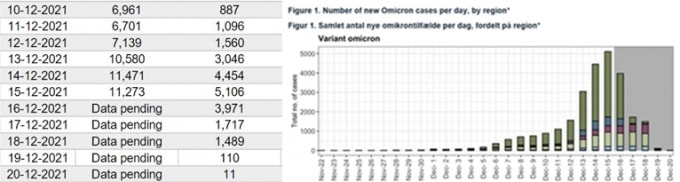
Daily Omicron cases,10~20th December 2021. /Photo=Statens Serum Institut
According to the Dec-25th2021 Washington Post the Scandinavian giant is an example that boosters are beacon of hope in curving the spread. According to the Statens Serum Institut(21st December 2021) the daily number of new Omicron cases in Denmark saw a steep decline after reaching its peak(887→ 1096→ 1560→ 3046→ 4454→ 5106→ 3971→ 1717→ 1489→ 110 → 11)
━
"Three factors for vaccine approval: Safety, Efficacy, and Availability"
━
Dr.Lars Bo Nielsen(left)·poster promoting vaccination. /Photo=Kim Taewook(left)·Dr. Lars Bo Nielsen Director General twitter
"It's never easy to give advice to other countries on vaccine policy" Director General said.
"I'm cautious as each respective nations are all different in terms of circumstances". He then went ahead "there are three factors to be considered when implementing a policy: safety, efficacy and availability". Safety and efficacy are top priorities, among others".
"However, the 'availability' needs to be carefully considered when implementing a policy" he explained. "Above all, comprehensive evaluation is the key along with the benefits and risks of vaccination".
━
"The safety of AstraZeneca and Janssen is proven"
━
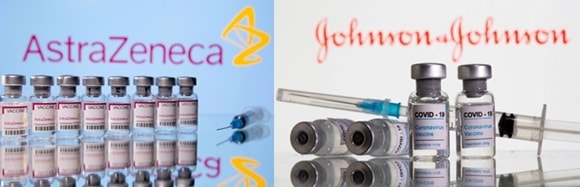
AstraZeneca(left)·Janssen vaccine. /Photo=REUTERS
"The safety of AstraZeneca and Janssen is proven. The fact that both labels passed verifications from the health authorities support my assertion" Director General stressed. "These vaccines are highly effective in terms of preventing COVID-19"
Director general continued "Copenhagen made the decision to utilize Pfizer as the main tool for the inoculation of age 5 to 11" "However, this does not in any way imply that the viral vectors should be refrained in further usage among other nations" he explained. "Copenhagen's decision stays inside the Danish border, as comprehensive and exhaustive research of safety, efficacy, and availability might differ from place to place"
"Moreover, it does not mean that all the vaccines in the future will only be mRNA-based" stressed the general. Pfizer and Moderna vaccines are mRNA-based, whereas Janssen and AstraZeneca vaccines are viral vector-based.
━
"Korea started massive PCR testing early in the pandemic… wonderful disease response system should be cherished and enshrined"
━
Director General praised Korea's response system to COVID-19(so called K-quarantine).
"As far as I remember, Korea is one of the few countries that conducted massive PCR testing from the infancy stage of the outbreak. Personally, Republic of Korea is a nation where excellent national medical system is rooted along with well-qualified medical staff"