


Where did so many fake products come from?
[MoneyS Report - China, an illegal fake country, is not ashamed (2)] Fake Chinese products hidden all over the internet

By Yeon Hee-jin and Kim Tae-wook , MoneyS

4,243




공유하기
-

카카오
-

카카오 나에게
-

페이스북
-

트위터
-

네이버
-

텔레그램
-

링크 복사
편집자주
Dubbed as ‘the fake republic’, China is speeding up its dominance in the "imitation market". As K-Food(including Korean cuisine) captures the world’s plate, Chinese came up with fake K-foods, such as ramen and seasoning. Such fake mockups is on the sale in Korea's online platforms. Beijing is also provoking ire by stealing Korean culture. Kimchi, Hanbok(Traditional clothes) and even contents are the latest cultural feud between South Korea and China. The following are concrete examples of blatent rip-offs, driven by the Chinese complexity.
The allegation was first raised from eagle eye that a few designs she wore were yet to be launched, but could be found in online markets. It shows well how the fake goods are widely distributed.
Online, paradise for fake goods?
Among those, 47,812 cases were sold through the open market and 32,304 cases were sold through SNS. Specifically, secondhand goods-exclusive platforms, Beongae (Lightening) Market (24,099 cases) and Hello Market (2284 cases) accounted for a large proportion. Fake goods were also found in major platforms such as Naver(Korea’s largest online service provider) smart Store , 1869 cases and NYSE-listed Coupang, 1560 cases.
A source familiar with the industry said “The tactics of distributing fakes online have become more sophisticated”. ”Recently, there have been many cases of illegal sales where acting- purchasing agents buy fakes, as if they were local products.” he added.
In fact, there was a case in one of the online platforms, where a Chinese registered himself/herself as Korea-based business and distributed fakes, as if the products were overseas direct purchase. Consumers have no idea they are being deceived until the fake arrives. It might be a bit early to jump to conclusions that all fakes in Korea are from China, but there is a clear reason why China is being suspected , whenever similar issues pop up.
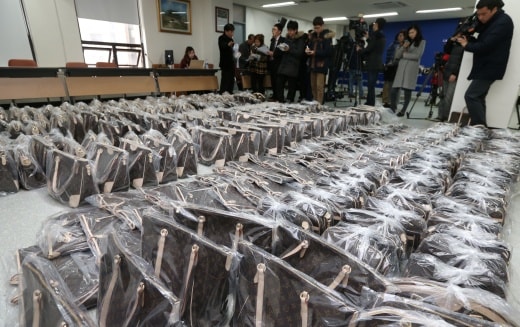
According to the data from Korea Customs Service(KCS) last year, the number of cases fake bags were detected from 2017 to August 2021 was 1,866, to the tune of 467.9 billion KRW. Overwhelmingly, 97.9% were from China, according to KCS.
Fakes viral online… Lack of ability to detect or lack of willingness to catch?

Counterfeit is the main problem in the e-commerce industry. This is because its near impossible to police all the products, poured into the market. Even if the thieves are kicked-out, it is difficult to prevent them from re-entering the market under another name.
The open markets, however, argue that its unfair. From their viewpoint, they are also victims of such fake goods, as the credibility might drop. Electronic commerce(E-Commerce) insist they have set up their own rules to police the fakes, roaming in the market.
Coupang, for example has a team dedicated to operate a 24/7 monitoring system. According to Coupang, they have started to utilize AI(artificial intelligence) technology to analyze the price of products and warn the possibility of fake goods, and also distinguish fake and real by analyzing images.
11st, Korea’s e-commerce platform established Post-monitoring system. An official from the 11st said “for the first time in the industry, we launched this system called ‘mystery shopping’, where the company itself purchases products, highly suspected of being fake ones, in order to evaluate first-hand whether its real or not”
eBay Korea, which operates G market and Auction, operates an office dedicated to eradicate counterfeits. If a customer files a report over a suspicious product within a year of purchase, G market and Auction will pay for the product and collect it for free and request for an evaluation. In addition, eBay refunds all fees customer charge if the purchase turns out to be a fake.
The problem is that assessment takes long time, and it always comes after the purchase is done. As fake goods are becoming more sophisticated and likely to set the price as close as genuine products , or settling it a slightly lower. It is becoming more difficult to police these blatantly obvious rip-offs.
Meantime, the lack of legal grounds in Korea is another reason for such problem. According to the ‘Act on consumer protection in E-commerce’ open markets are not subject to punishment , even if fakes were sold. The National Assembly is seemingly trying to amend the act and impose more responsibility and liabilities to the online platforms, but no concrete movement has been observed.
One of the sources said on condition of anonymity “It’s a challenge to stop the Chinese sellers joining the open market”. “In fact, we need more cooperation and support from the trademark holders in order to identify the counterfeit products” he added.
<저작권자 ⓒ ‘존중받는 개인, 부강한 대한민국’ 시대, 무단전재 및 재배포 금지>
<보도자료 및 기사 제보 ( [email protected] )>